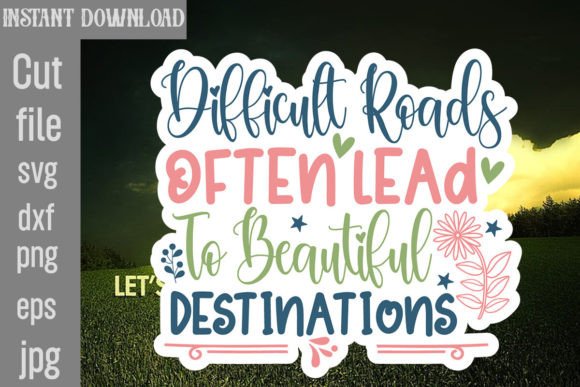
Difficult Roads Often Lead to Beautiful
As a designer who spends half my life staring at stitch charts and the other half troubleshooting tension issues on the embroidery machine, I don’t just buy designs; I evaluate them. I look for that elusive balance between aesthetic appeal and technical feasibility. When I first pulled up Difficult Roads Often Lead to Beautiful, I didn’t see just another quote design. I saw a narrative waiting to be stitched into fabric. This isn’t about slapping text on a shirt; it’s about creating a finished product that feels intentional, durable, and deeply personal. Whether you are an Etsy seller looking for your next best-seller or a crafter making a gift for a friend, understanding how this design translates from digital file to physical object is crucial.
The First Impression: Mood and Visual Weight
The title alone sets a tone of resilience and optimism, but visually, the layout dictates how it will behave under the needle. Difficult Roads Often Lead to Beautiful carries a specific visual weight. It doesn’t scream for attention with neon colors or chaotic shapes; instead, it relies on strong typography and perhaps a subtle graphic element that suggests a path or journey. In the world of Crafts and Graphics, this kind of understated strength is often more valuable than loud novelty. It appeals to the buyer who wants something they can wear daily without feeling like a walking billboard. The mood is reflective, grounded, and mature. It fits perfectly into the current trend of "quiet luxury" in handmade goods, where quality and sentiment outweigh flashy trends.
From a design perspective, the composition likely uses negative space effectively. This is critical for embroidery because empty space allows the eye to rest and gives the stitching room to breathe. If the design were too cluttered, the resulting embroidery project might feel heavy or distorted. Instead, this design promises clarity. It suggests that the artist behind it understands that less is often more, especially when dealing with the limitations of thread density and fabric grain.
Real-World Application: From Screen to Stitch
Let’s talk about where this design actually lives. Imagine you are preparing a custom order for a client who just launched their own small business or survived a major life transition. You decide to create a premium custom apparel piece. Difficult Roads Often Lead to Beautiful works exceptionally well on heavyweight cotton blends, such as those used in high-quality sweatshirts or structured tote bags. The contrast between the softness of the fabric and the crispness of the stitches creates a tactile experience that customers love.
I also see this design thriving in the realm of personalized gifts. A mother buying a graduation gift for her child, or a friend gifting a post-recovery care package, would find deep meaning in this phrase. When stitched onto a baby embroidery item like a muslin blanket or a onesie, the message takes on a protective, hopeful tone. However, placement is key. On a tote bag design, centering the design ensures it remains visible and legible even when the bag is full. On a sweatshirt embroidery, placing it slightly off-center on the chest or centered on the back can offer a modern, boutique feel that stands out against mass-produced retail options.
For Etsy sellers and small shop products, versatility is money. This design is not limited to one type of garment. It can adapt to aprons for home cooks, pillow covers for nursery decor, or even embroidered patches for denim jackets. The ability to scale this design across different mediums without losing its integrity makes it a robust asset for any craft business. It bridges the gap between commercial embroidery needs and heartfelt, handmade product authenticity.
Where Caution Is Required
No design is perfect for every situation, and a professional reviewer must point out the pitfalls. While Difficult Roads Often Lead to Beautiful is versatile, it demands respect for the material constraints. Avoid using this design on extremely thin or stretchy fabrics unless you are using a high-density stabilizer. Thin materials can pucker or distort, ruining the clean lines of the typography. Similarly, textured fabrics like chunky knits or bouclé wool can hide the finer details of the stitch density, making the design look muddy rather than sharp.
Be mindful of hoop size limitations. If the design includes intricate corners or very small lettering, ensure your machine’s hoop can accommodate it without cutting off essential elements. Curved surfaces, such as caps or hats, require careful digitizing adjustments to prevent distortion. If the design relies heavily on fine satin stitch work for outlines, test it thoroughly. On dark fabrics, ensure there is enough contrast in your thread colors; otherwise, the message gets lost in the weave. Always inspect the design in black and white mockups before committing to expensive threads. This simple step reveals whether the shape holds up without the crutch of color.
Technical Considerations for the Designer
When integrating Difficult Roads Often Lead to Beautiful into your workflow, start by testing on scrap fabric. This is non-negotiable. Check the stabilizer choice—cut-away stabilizers are generally safer for garments that will undergo frequent washing, while tear-away might suffice for一次性 items like tea towels. Pay close attention to the fill stitch areas. Are they dense enough to cover the fabric completely? Too sparse, and you’ll see the backing; too dense, and the fabric becomes stiff and uncomfortable.
Also, consider the licensing implications if you plan to sell finished items. Even though this is a digital embroidery file available for download, commercial rights vary. Ensure you have the proper license to produce and sell finished product units. For printable mockups and design assets used in marketing, you may need separate permissions. Transparency builds trust with your customers, and clear communication about what you are selling protects your brand consistency.
Final Verdict: A Design with Depth
In a market saturated with generic quotes, Difficult Roads Often Lead to Beautiful stands out because it feels authentic. It doesn’t try too hard. It offers a sturdy foundation for a wide range of embroidery projects, from intimate personal gifts to scalable small business merchandise. Its success lies in its simplicity and emotional resonance. For designers willing to put in the prep work—checking tension, choosing the right fabric, and respecting the stitch limits—this design rewards you with a professional, polished result that customers will cherish. It is more than just a machine embroidery design; it is a statement piece that adds value to any handmade product line.
If you are looking to expand your catalog with items that speak to resilience and beauty, this is a strong addition. It works beautifully for holiday embroidery collections, wedding favors, or everyday wear. Just remember: the quality of the final output depends largely on the preparation. Test, adjust, and stitch with confidence. The road to a beautiful finished product is indeed difficult, but with the right tools and insights, it is entirely worth the journey.